Stablecoin on-ramp and off-ramp explained: how to launch for your customers
A practical guide to stablecoin on-ramp and off-ramp infrastructure in 2026, including customer onboarding, KYC, virtual accounts, approvals, and automation.
By Compose Team
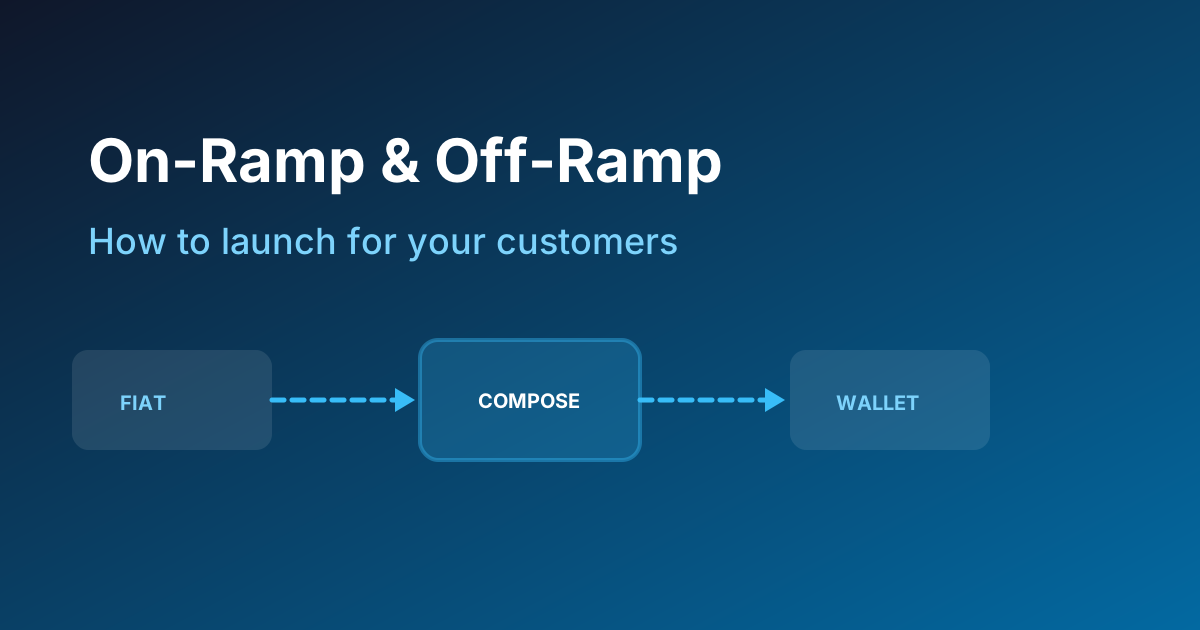
The hard part of stablecoins is not sending tokens.
The hard part is everything around them.
Customers still need to move money from bank accounts into wallets. They still need to come back out of wallets into bank accounts. Your team still needs KYC, approvals, reconciliation, payout controls, and support-ready transaction history.
That's why every serious stablecoin product ends up solving the same problem:
How do we move customers cleanly between fiat rails and crypto rails without forcing them to think about the plumbing?
That is what on-ramp and off-ramp infrastructure is really for.
Not hype. Not speculation. Not "Web3 UX."
Just reliable money movement.
In this article
- What stablecoin on-ramps and off-ramps actually are
- The main product patterns businesses launch
- What infrastructure you need before going live
- Common launch mistakes
- How Compose helps teams ship faster
What is a stablecoin on-ramp?
A stablecoin on-ramp is the flow that moves a customer from fiat into stablecoins.
Usually, that means a customer sends money from a bank account, and your infrastructure converts it into a stablecoin such as USDC and delivers it to a wallet or platform balance.
In other words:
fiat in → stablecoin out
That sounds simple. But the real product is everything wrapped around it:
- Customer creation
- KYC
- Deposit instructions
- Payment identification
- Currency conversion
- Wallet routing
- Transaction tracking
- Notifications and webhooks
Without those layers, you do not have an on-ramp. You have an unfinished payment flow.
What is a stablecoin off-ramp?
A stablecoin off-ramp does the reverse.
A customer or business sends stablecoins, your infrastructure converts them into fiat, and the funds are paid out to a linked bank account.
In other words:
stablecoin in → fiat out
For many businesses, the off-ramp matters even more than the on-ramp.
It is what turns stablecoins from an interesting payment rail into something finance teams can actually use. Because eventually, most businesses need to pay someone in fiat — an employee, a vendor, a tax authority, or a bank account they control.
If the money cannot come back out cleanly, the product is incomplete.
Why businesses launch on-ramp and off-ramp products
Most platforms are not launching on-ramp and off-ramp infrastructure because they want to build a crypto exchange.
They launch it because their users already live across both systems:
- Bank accounts
- Wallets
- Fiat balances
- Stablecoin balances
And users do not want to manage the hops manually.
A customer wants to send euros from a bank account and receive USDC. Another wants to send USDC from an external wallet and cash out to a bank account. A platform wants to monetize the flow, keep approvals in place, and update product state in real time.
That is not one feature. It is a connected workflow.
The main launch patterns
1. Reference-based shared account deposits
This is one of the fastest ways to launch an on-ramp.
The customer gets shared banking details plus a unique reference code. They send fiat to that account, your system identifies the transfer based on the reference, and the funds are converted into stablecoins.
This model works well when you want a simple bank-to-stablecoin flow without issuing a dedicated account to every customer.
The tradeoff is user experience. Reference-based deposits work, but they require customers to enter the right reference every time.
2. Dedicated virtual accounts
This is the cleaner version of the same flow.
Instead of sending money to a shared account with a reference, the customer gets a dedicated virtual account or virtual IBAN. Deposits are identified by the account itself, which removes friction and reduces support issues.
This is often the right model when you want a stronger product experience and more predictable payment identification.
For many businesses, virtual accounts are where a stablecoin on-ramp starts to feel like a real banking product instead of a workaround.
3. Direct-to-wallet delivery
Once fiat is received and converted, the stablecoins need somewhere to go.
That can be:
- Your organization wallet
- A customer's registered wallet
- A custodial balance on your platform
Direct-to-wallet delivery is especially useful when customers want to receive USDC into an external wallet without extra manual steps.
4. Manual off-ramps with approval
Not every payout should auto-execute.
In many businesses, off-ramp withdrawals need a human approval step before funds move. That might be for treasury control, fraud prevention, or internal policy.
In that model, a withdrawal request is created, moves into a proposed state, and waits for an approver to sign.
This is slower than fully automated execution, but it gives teams tighter control over outgoing funds.
5. Automated off-ramps with limits
Once the workflow is proven, many teams want to automate smaller or lower-risk payouts.
That means defining withdrawal allowances, daily thresholds, or approval logic so payouts can process automatically within pre-set rules.
This is where stablecoin infrastructure starts to create real operational leverage. You are no longer manually reviewing every payout. You are designing the rules once and letting the system execute them predictably.
6. Customer-initiated off-ramps
Some products go even further.
A customer links a verified bank account, receives a designated wallet or linked withdrawal destination, then sends USDC from an external wallet whenever they want to cash out. The system detects the incoming funds, converts them, and pays out fiat automatically to the linked bank.
That turns off-ramping into a self-serve customer action instead of a support workflow.
What you need before you launch
This is where many teams underestimate the work.
To launch an on-ramp or off-ramp that customers can actually trust, you need more than conversion logic.
1. Customer creation and identity verification
Before funds move, you need to know who is moving them.
That means:
- Creating customer profiles
- Collecting identity details
- Initiating KYC
- Tracking verification progress
- Handling approval, rejection, and retry states
If those states are not clean, your money movement product never feels reliable.
2. Deposit instructions and account provisioning
Customers need a clear way to start the payment flow.
That may be:
- Shared account deposit details with a reference
- A dedicated virtual IBAN
- A deposit wallet for direct stablecoin receipts
The key is clarity. If customers are unsure where to send funds, which currency to use, or how a payment is identified, volume drops and support tickets rise.
3. Wallet registration
If the end state of the on-ramp is "deliver stablecoins to the customer," then wallet registration matters.
You need to:
- Save the right wallet
- Validate the address format
- Tie it to the correct customer
- Prevent operational errors before funds move
4. Withdrawal bank setup
The off-ramp cannot work unless the destination bank account is configured and approved.
That means collecting bank details, verifying the recipient type, and keeping those payout destinations tied to the right customer.
5. Real-time transaction states
On-ramp and off-ramp products live or die on state visibility.
Your internal teams need to know:
- Deposit created
- Deposit completed
- Withdrawal proposed
- Withdrawal processing
- Withdrawal completed
- Withdrawal failed
- KYC pending
- Bank approved
- Virtual account ready
When your product exposes those states cleanly, support becomes easier, finance gets better visibility, and automation becomes possible.
6. Security and approvals
Outgoing money needs controls.
That means setting signer permissions, approval thresholds, and secure authorization methods for withdrawals and treasury actions.
For many businesses, this is where passkey-based multi-sig becomes a major advantage. It gives teams strong approval controls without forcing operators to manage seed phrases or brittle wallet workflows.
7. Webhooks and automation
Customers should not wait for your team to refresh a dashboard.
If KYC finishes, your app should know. If a deposit lands, your app should know. If a virtual account becomes active, your app should know. If a withdrawal changes status, your app should know.
That is what makes on-ramp and off-ramp infrastructure feel like a product instead of a back office process.
Common mistakes teams make
Mistake 1: Launching the on-ramp and ignoring the off-ramp
Teams often focus on getting money into stablecoins and treat the exit path as something they will solve later.
But "later" is when operational pain shows up.
Customers eventually want to cash out. Treasury teams eventually want fiat liquidity. If the off-ramp is weak, trust in the whole product drops.
Mistake 2: Relying on manual reconciliation
If deposits require your ops team to match references, check wallets, and update balances manually, the product will not scale.
This is where reference codes, virtual accounts, transaction history, and webhook events matter so much. They remove the detective work.
Mistake 3: Approving everything by hand forever
Manual approval is fine at the start. It is not a long-term operating model.
At some point, stablecoin infrastructure has to become rule-driven. Otherwise every payout becomes a bottleneck.
Mistake 4: Using separate tools for every step
One provider for KYC. Another for banking. Another for wallets. Another for payouts. Another for approvals.
You can make that work. But every handoff between systems becomes a failure point.
The customer only sees one product. Your stack should act like one.
Mistake 5: Forgetting monetization
If your platform enables money movement for customers, you should be able to price and monetize it intentionally.
That might mean spreads, service tiers, or usage-based pricing. But it should be part of the design, not an afterthought.
How Compose helps teams launch on-ramp and off-ramp products
Compose gives businesses the building blocks to launch stablecoin money movement without stitching together the entire stack themselves.
With Compose, you can:
- Create customer profiles
- Initiate hosted KYC flows
- Upload and track verification documents
- Provision deposit instructions
- Create dedicated virtual accounts
- Register customer wallets for direct-to-wallet delivery
- Quote fiat-to-stablecoin and stablecoin-to-fiat flows
- Configure payout bank accounts
- Create withdrawals with manual approval or automated execution rules
- Track transaction history and statuses
- Receive webhook events across the customer and payment lifecycle
- Secure operations with self-custody, Safe-based multi-sig, and passkeys
- Configure developer fees to monetize money movement
That means you can build around one lifecycle:
onboard customer → verify identity → provision account or wallet → receive funds → convert → deliver → withdraw → reconcile
That is the real product.
A simple example flow
Here is what a basic on-ramp flow can look like in practice:
const customerRes = await fetch("https://compose.finance/api/v2/customers", {
  method: "POST",
  headers: {
    "Content-Type": "application/json",
    Authorization: "Bearer YOUR_API_KEY",
  },
  body: JSON.stringify({
    name: "Ada Lovelace",
    accountType: "individual",
    email: "[email protected]",
    expectedMonthlyVolume: 25000,
  }),
});

const customer = await customerRes.json();

const kycRes = await fetch(
  `https://compose.finance/api/v2/customers/${customer.customerId}/kyc`,
  {
    method: "POST",
    headers: {
      Authorization: "Bearer YOUR_API_KEY",
    },
  }
);

const kyc = await kycRes.json();
console.log(kyc.kycFlowLink);
From there, you can wait for verification, provision deposit instructions or a virtual account, register a wallet, and start routing funds.
Launch the workflow, not just the conversion
Stablecoin on-ramp and off-ramp products succeed when they feel boring in the best possible way.
The customer knows where to send funds. The platform knows who they are. The system knows what state the transaction is in. The operator knows what needs approval. Finance knows how to reconcile it.
That is what customers are actually buying.
Not a token conversion.
A reliable bridge between bank rails and wallet rails.
Compose helps teams build that bridge with one platform for onboarding, verification, deposits, payouts, approvals, and automation.
If you want to launch stablecoin on-ramp and off-ramp flows your customers can actually trust, Compose gives you the infrastructure to do it.